Job Search: Don’t Be Intimidated By All The New Terms
One of the first things I noticed getting back into the job search arena was all the new terminology connected to searching for a job. With AI-assisted everything everywhere, I was familiar with a few terms, but as I have interviewed these last few weeks, more terms have come to my attention, adding to my education, confusion, and frustration.
Just thinking about how to write in areas like this is so easy to go to ChatGPT, ask it a question and let it dazzle you with a 1,500-word document all formatted and pretty. It gave you exactly what you asked for. Instead of copying and pasting from Wikipedia, like back in the day, AI gives you a polished piece fit for the trash. After reading what it wrote you soon come to realize it’s no different from keyword stuffing in the early days of the Internet.
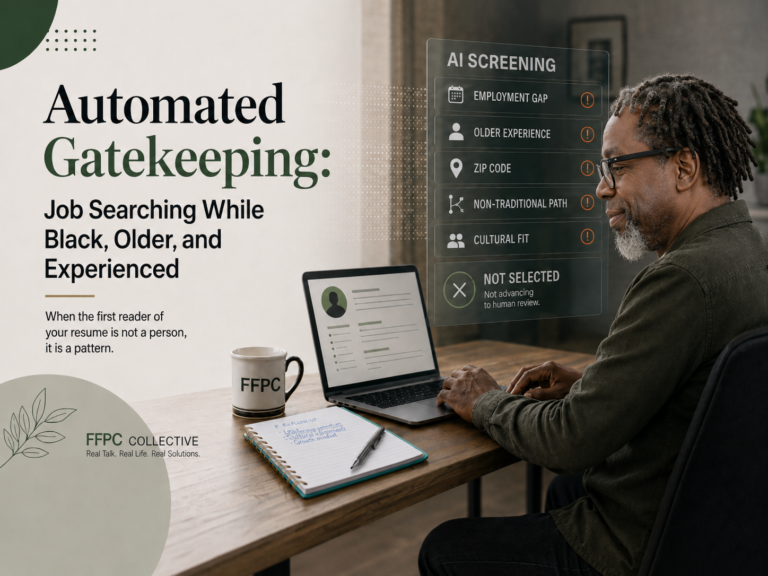
A few years ago, letting the AI tools look over my resume and make it “ready” based on some magical fairy dust formula I trusted to make my resume 100% ready based on what “they” said was suitable to get past 2020 HR bots felt more like I was gamifying my resume instead of job hunting. Needless to say, none of those early versions of my resume landed me a job or even an interview.
The newest term I was introduced to is experiential retail. I knew about experiential learning but had never heard of a retail connection. It is retail built around the customer experience, not just transactions. I had a light bulb moment realizing if the job search had evolved, then job descriptions had to evolve along with it. The evolution today is part descriptors and part buzzwords. Buzzwords, for the most part, are my pet peeve. I have never cared for them, therefore I never learned many nor their meanings. So I will play along even if I don’t care for it.
If I want to interview well and relegate the Attica Files to another lane of traffic blog-wise, I have to know what is out there and how I can best use it, which brings me to the next new terms AI-assisted and AI-authored. This post, as well as a portion of my blog, are AI-assisted. Trying to run a blog as a business has many moving parts and just like any business has many people in different roles, I use AI tools in the same way.
FFPC PSA Moment:
How can you tell if something is all AI? It’s too perfect, promises you the world for next to nothing and is vague on verifiable results. I know some new terms will pop up as a result of this and you should too. If critical thinking is not your strong suit, tread lightly in the world of AI and online job searching.
Back to new terminology and AI. AI is not new, but public access is new. Its origin story begins shortly before I was born. Job hunting then looks different from today in a world of job searching with an implied requirement of using AI tools versus typing up a resume, printing it on good paper and using a roll of stamps to mail them out to dozens of companies. Millions of resumes going out to thousands of companies for real and ghost positions. I learned about ghost positions while working so I guess that counts as a job-related term instead of a job search term even though it is similar. Regardless, it makes my brain hurt.
I may be the brains of the operation but I want to be able to use AI to help me gather my thoughts as well as create some things that I was not aware of. If I acknowledge the assistance I get from AI will it help or hurt me in the world of AI slop? Will I develop AI sense like spider sense? Since everybody is using AI to make their resume AI-bot-proof does that mean that all current resumes are garbage and I would be better off earning a certificate in “AI-nothingness”?
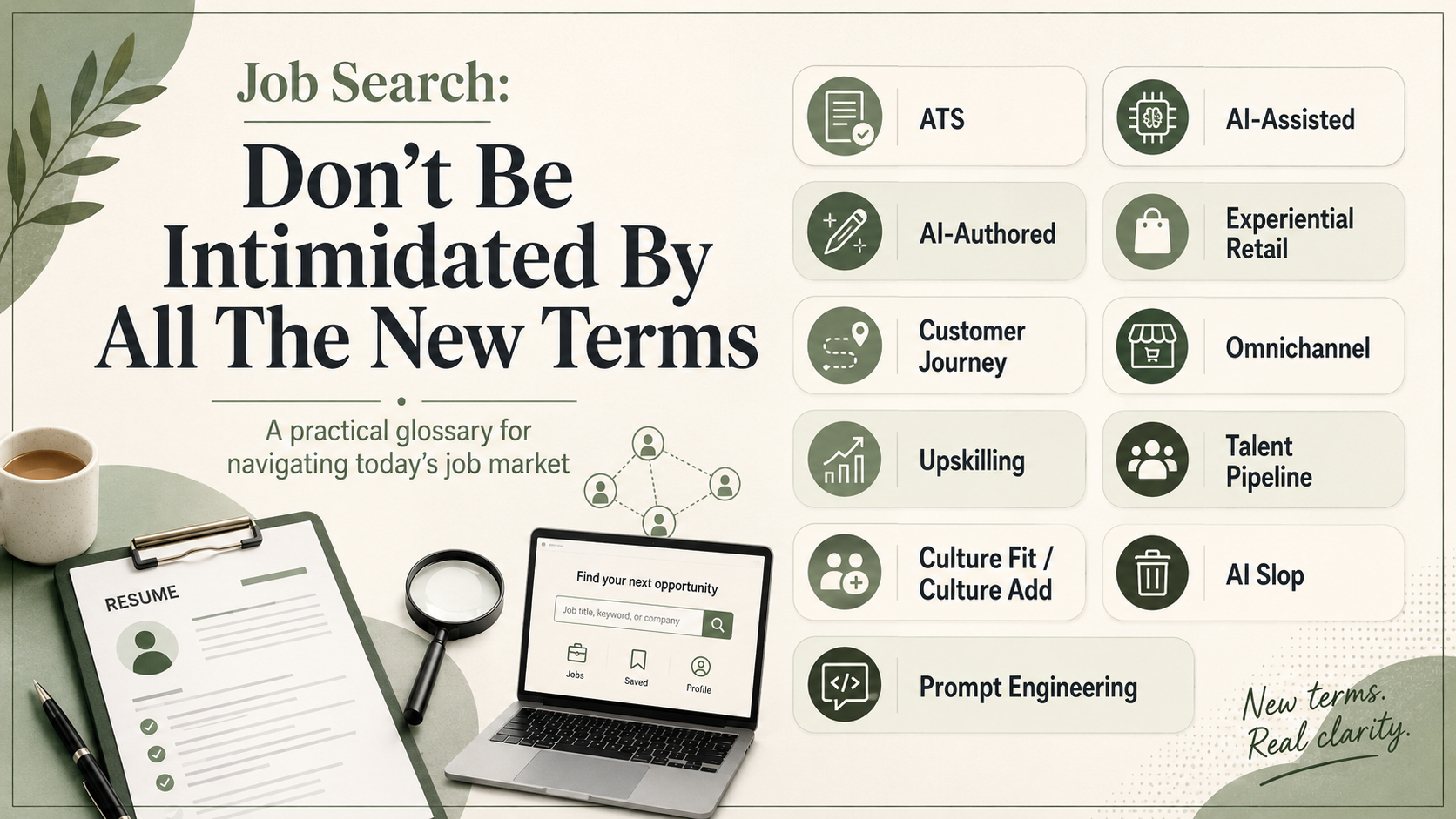
The job search continues with more tools for the toolbox and a better understanding of how and when to use the tools I already have. Below is a glossary of known and a few new terms I have come across. If there are any terms you have come across that are not listed, leave them in the comments or drop me a message.
Job and Job-Related Glossary
AI-assisted writing
A person is still the author, but AI helped with brainstorming, outlining, editing, cleanup, examples, or structure.
AI-authored
AI created the main writing, structure, or wording, even if a person reviewed or lightly edited the final version.
AI detection
Tools that claim to identify whether text was written by AI. This area is shaky. Researchers have warned that detectors struggle in real-world conditions and can misclassify writing, especially when a human wrote it and AI only polished it.
AI disclosure
Telling readers, employers, customers, or platforms that AI was used. The tricky part is that disclosure can help with honesty, but research is also showing that people may judge disclosed AI-assisted writing differently, sometimes less favorably.
AI-generated content
The machine created most or all of the writing, image, audio, or video. It is the broad umbrella term.
AI-polished writing
Human-written text that AI lightly cleaned up. This is becoming important because AI detectors often struggle to tell the difference between fully AI-written work and human work that was only edited or polished by AI.
AI slop
The rough street term for low-quality, high-volume AI content pushed online with little care for accuracy, usefulness, or human point of view. Merriam-Webster defined it as low-quality digital content usually produced in quantity by AI, and recent coverage keeps using it for junky AI text, images, videos, and search clutter.
ATS
Applicant Tracking System. The software that stores and screens resumes before a human may ever see them. This is why wording from the job posting matters.
Content provenance
Tracking where content came from and how it was made. In plain English: who made this, what tools touched it, and can we verify that?
Culture fit / culture add
“Culture fit” means whether you match how the workplace operates. “Culture add” is the better version, meaning what perspective, maturity, and experience you bring that improves the place.
Customer journey
The full path a customer takes from first hearing about a place or product to visiting, buying, returning, asking questions, or becoming loyal.
Experiential retail
Retail built around the customer experience, not just transactions. Think events, demonstrations, storytelling, community connection, hands-on service, and creating a reason for people to come into the store.
Human-authored
The ideas, structure, and main writing came from a person, even if tools helped with grammar or layout.
Human-in-the-loop
A real person is still reviewing, deciding, correcting, and taking responsibility for the final work.
Omnichannel
A business serving customers across multiple channels: in-store, website, app, email, social media, curbside, delivery, or phone. Retail loves this word now.
Prompt chaining
Using several prompts in sequence instead of expecting one magic answer. For example: brainstorm first, outline second, draft third, polish fourth.
Prompt engineering
Knowing how to ask AI for the kind of output you need. The term is already a little inflated, but job postings and creator tools still use it.
Talent pipeline
The pool of people an employer may hire or promote later. It can refer to recruiting, internal development, succession planning, or entry-level workers growing into bigger roles.
Upskilling
Learning new skills for your current or next role. In today’s market, this often means software, AI tools, leadership methods, data, customer systems, or compliance training.